- Producer
- Trapet Père & Fils
- Grape variety
- Pinot Noir (Spätburgunder)
- Region
- Côte de Nuits
- Country
- France
- Vintage
- 2023
- Alcohol
- 13 % vol
- Volume
- 1.5 l
- Item no.
- 9910222171
Shipped with DHL Express — customs cleared to your door. · Flat-rate shipping CHF 15.00 — free from 12 bottles or CHF 300.00. · Pay by TWINT or card.
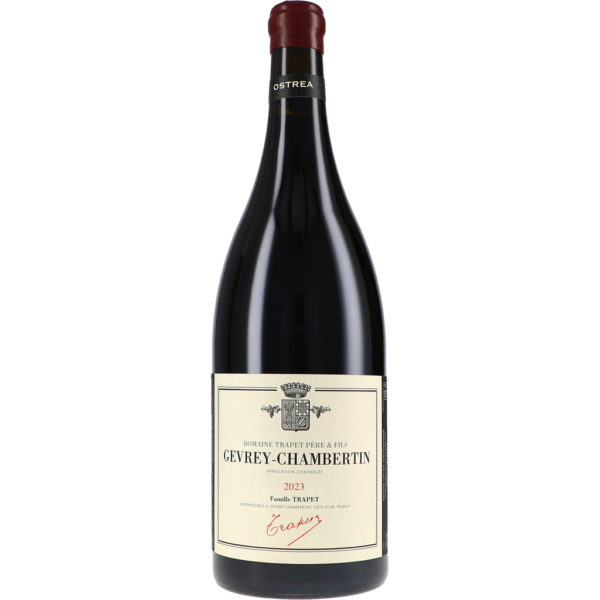
Gevrey-Chambertin Cuvée Ostrea AOC 2023 1500ml Magnum
The Gevrey-Chambertin Cuvée Ostrea 2023 from Trapet Père & Fils is a single-varietal Pinot Noir from soils in which Jean-Louis Trapet found fossilized oyster shells.
CHF 258.50
Prices in CHF, including customs duty and all import charges, plus shipping CHF 15 (free from 12 bottles or CHF 300) — no further charges on delivery.
Available for Switzerland
Magnum — counts as 2 bottles in the case.
✓ On your wishlist. — View wishlist
About this wine
Character
A Gevrey-Chambertin that tells its origin through clarity rather than power: fine-grained tannin, aromatic depth, structure without heaviness. Jean-Louis Trapet leads the domaine in its seventh generation, guided by the principle of accompanying the grapes rather than ever forcing them.
Terroir and origin
The cuvée's name comes from the fossilized oyster shells that Jean-Louis Trapet found in his Gevrey-Chambertin parcels. These soils were once seabed, giving the wine its saline, chalky signature beneath the cherry fruit. The domaine farms 18.5 hectares in Gevrey-Chambertin, biodynamically since 1996.
Grape variety and vinification
Single-varietal Pinot Noir. In the cellar, Trapet works by gravity and with restrained intervention; for the villages wines, the proportion of new oak is 20 to 25 percent, keeping the barrel in the background. 13.0% ABV, dry. The 1500 ml magnum format slows the wine's aging in bottle.
On the palate
Dark cherry, cassis and raspberry, along with violet and an earthy note of undergrowth. The body is medium-weight and silky, the tannin fine, the acidity lively. The finish stays long, carrying the chalky minerality through to the end.
Food pairing
With roasted venison or wild boar, with coq au vin, or with cheese such as aged Comté or Époisses.
Special features
In the 1880s, Arthur Trapet secretly grafted his vines onto American rootstock, at a time when this was still forbidden; the method was legalized in 1888. Jean-Louis Trapet has run the estate since the 1990s and, together with his wife Andrée, also manages Trapet Alsace in Riquewihr.