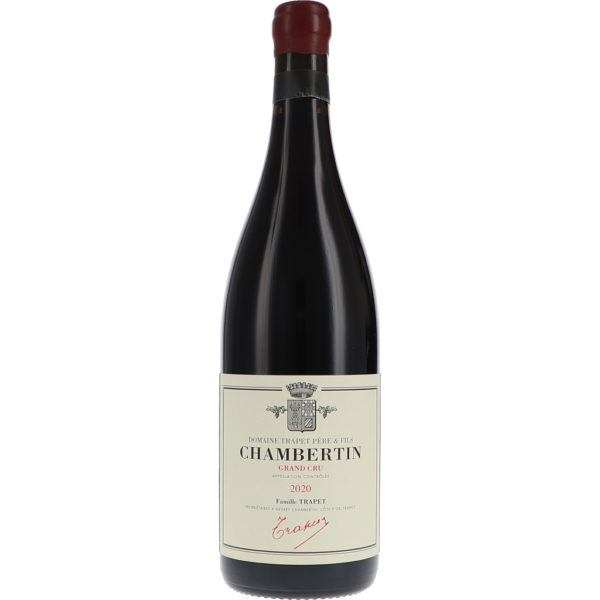
- Producer
- Trapet Père & Fils
- Grape variety
- Pinot Noir (Spätburgunder)
- Region
- Burgund
- Country
- France
- Vintage
- 2008
- Alcohol
- 13 % vol
- Volume
- 0.75 l
- Item no.
- 9910222034
Shipped with DHL Express — customs cleared to your door. · Flat-rate shipping CHF 15.00 — free from 12 bottles or CHF 300.00. · Pay by TWINT or card.
Chambertin Grand Cru 2008
The Chambertin Grand Cru 2008 from Trapet Père & Fils is a Pinot Noir from just under two hectares of Grand Cru vineyard in Gevrey-Chambertin, partly from century-old vines.
CHF 1'059.50
Prices in CHF, including customs duty and all import charges, plus shipping CHF 15 (free from 12 bottles or CHF 300) — no further charges on delivery.
Available for Switzerland
✓ On your wishlist. — View wishlist
About this wine
Character
This Chambertin favors finesse over force: aromatic depth, fine-grained tannin, transparency for its terroir. The 2008 vintage feels taut and precisely built, with a saline minerality beneath the fruit.
Terroir and origin
Domaine Trapet Père & Fils in Gevrey-Chambertin farms 18.5 hectares, with three Grand Crus forming its heart. The Chambertin accounts for just under two hectares, split across three parcels, partly with century-old vines. Jean-Louis Trapet, seventh generation, has farmed his plots biodynamically since 1996, following the creed "Les hommes passent et la terre reste".
Grape variety and vinification
100 percent Pinot Noir. For the Grand Crus, 50 to 100 percent whole clusters go into fermentation, the cellar works by gravity, and the share of new oak stays at no more than 50 percent. The guiding principle is to accompany, not to force.
On the palate
Medium ruby red with mature highlights. On the nose, dark morello cherry, undergrowth, and spice. The wine stays silky, the fine-grained tannin carries without gripping, the acidity keeps it fresh. 13.0% ABV, dry.
Food pairings
Feathered game such as pheasant and quail, as well as pink-roasted duck breast or boeuf bourguignon. For cheese, a ripe, mild Époisses.
Distinctive features
In the 1880s, Arthur Trapet secretly grafted onto American rootstock, at a time when this was still forbidden; the method was legalized in 1888. The Guide des meilleurs vins de France lists the domaine with three stars, its highest rating.